
The Junction
An easy district for browsing along Dundas before dinner, with a strong main-street feel. Its older commercial blocks make it feel distinct from the denser nightlife corridors farther southeast.
Spending time here
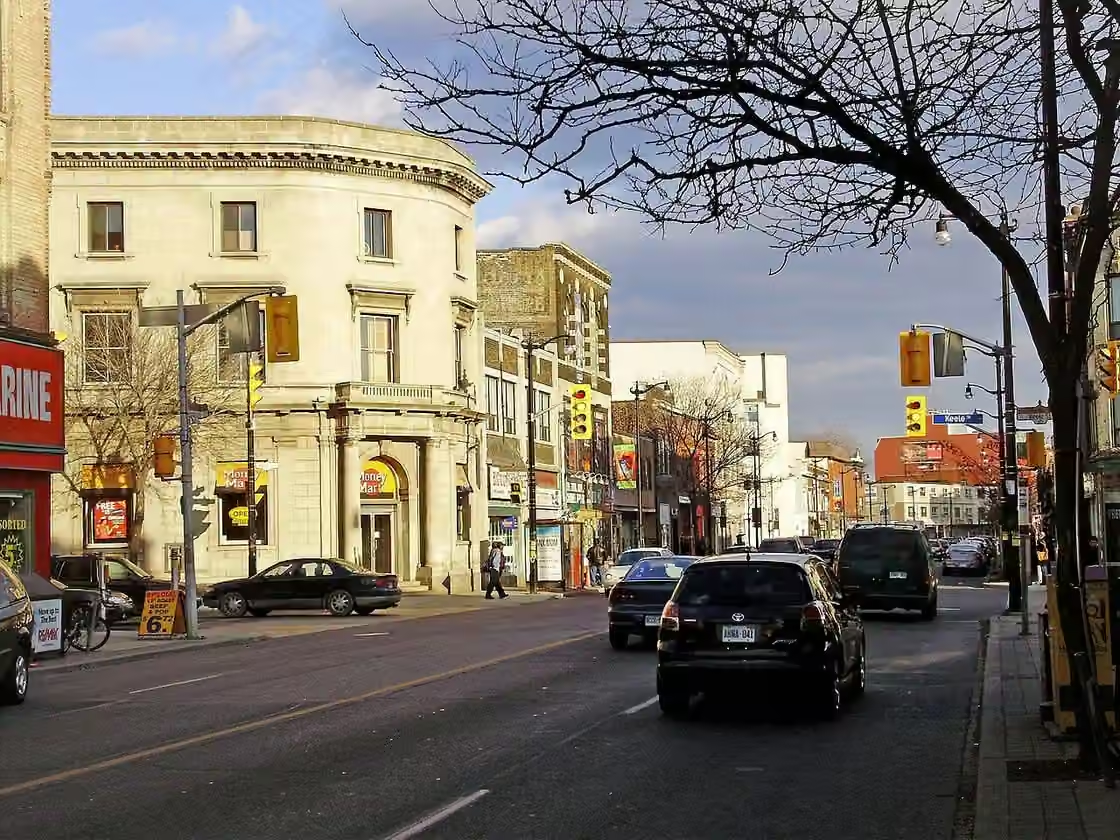
The present business district centres on Dundas around Keele, with the BIA stretching roughly from Indian Grove to Quebec Avenue. Older commercial blocks give the street a continuous frontage, while the intersections and side streets reveal how the centre connects with residential areas. The retained architecture makes the historical scale of the district visible even where the original businesses are gone.
For an outing, choose a section of Dundas and leave room to browse before a meal. The Junction’s appeal comes partly from the ability to spend time on a functioning main street rather than move between distant attractions. An evening can work as well for friends as for a date, depending on the room and programme you choose. The nearby Junction Triangle has a related railway history but is a distinct district with its own geography. A venue on Sterling Road should therefore be treated as a separate destination when checking the walking distance, rather than assumed to be just around the corner from Dundas and Keele.
Looking above the storefronts makes the older town centre easier to recognise. Upper floors and corner buildings often retain a more continuous architectural character than the changing signs below. The contrast is a useful reminder that commercial renewal usually happens inside a street pattern built for earlier businesses.
A railway town of its own
The Junction’s name comes from the meeting of railway routes in Toronto’s west end. The tracks brought employment and made the area attractive to manufacturers, while nearby housing served workers and their families. Its development was closely tied to the wider ambitions of Canada’s railway economy. Dundas and Keele became the focus of a commercial centre serving a community with its own institutions and municipal identity.
Before joining Toronto, the area passed through village and town government and became the City of West Toronto in 1908. Annexation followed in 1909. The West Toronto Junction Historical Society emphasises the independence and civic ambition of that brief city. This history helps explain the continuing feeling of a separate town centre: the commercial strip was built to serve a local municipality, rather than simply to extend the downtown shopping streets.
Industry, temperance and the main street
Industrial growth supported businesses ranging from piano manufacturing to vehicle production. The Heintzman factory became one of the area’s best-known employers. Rail work and manufacturing also supported hotels and taverns. In 1904, residents voted to prohibit alcohol sales, following campaigns concerned with the social effects of drinking. The City’s historical research dates the implementation of the ban to May of that year.
The long period of local prohibition later became central to the Junction’s public image. Restrictions were unwound through local votes in the 1990s, followed by the return of licensed establishments. That change was one ingredient in a broader commercial transition; it should not be mistaken for the entire history of neighbourhood renewal. Older buildings, the local customer base and the availability of premises also shaped what could open here.
Sources & further reading
Researched from the sources below. The description of the neighbourhood’s character is SceneTO’s editorial interpretation.
City of Toronto: West Toronto Junction historic context ↗West Toronto Junction Historical Society: Junction history ↗Junction BIA: district history and boundaries ↗Keep exploring
All neighbourhoods ↗ West Toronto
Little Italy
A broad restaurant street with patios and evening activity, surrounded by quieter residential blocks. It suits dinner followed by a short walk, with enough variety to avoid committing the whole night to one venue.
 West Toronto
Ossington
Concentrated and sociable, especially in the evening, with restaurants close enough to combine with a drink and a walk. The residential streets immediately alongside it have a much quieter rhythm.
 West Toronto
West Queen West
A long, varied stretch for browsing and going out, with the park providing a pause between commercial blocks. It works best when you choose a smaller cluster rather than trying to cover the whole street in one evening.